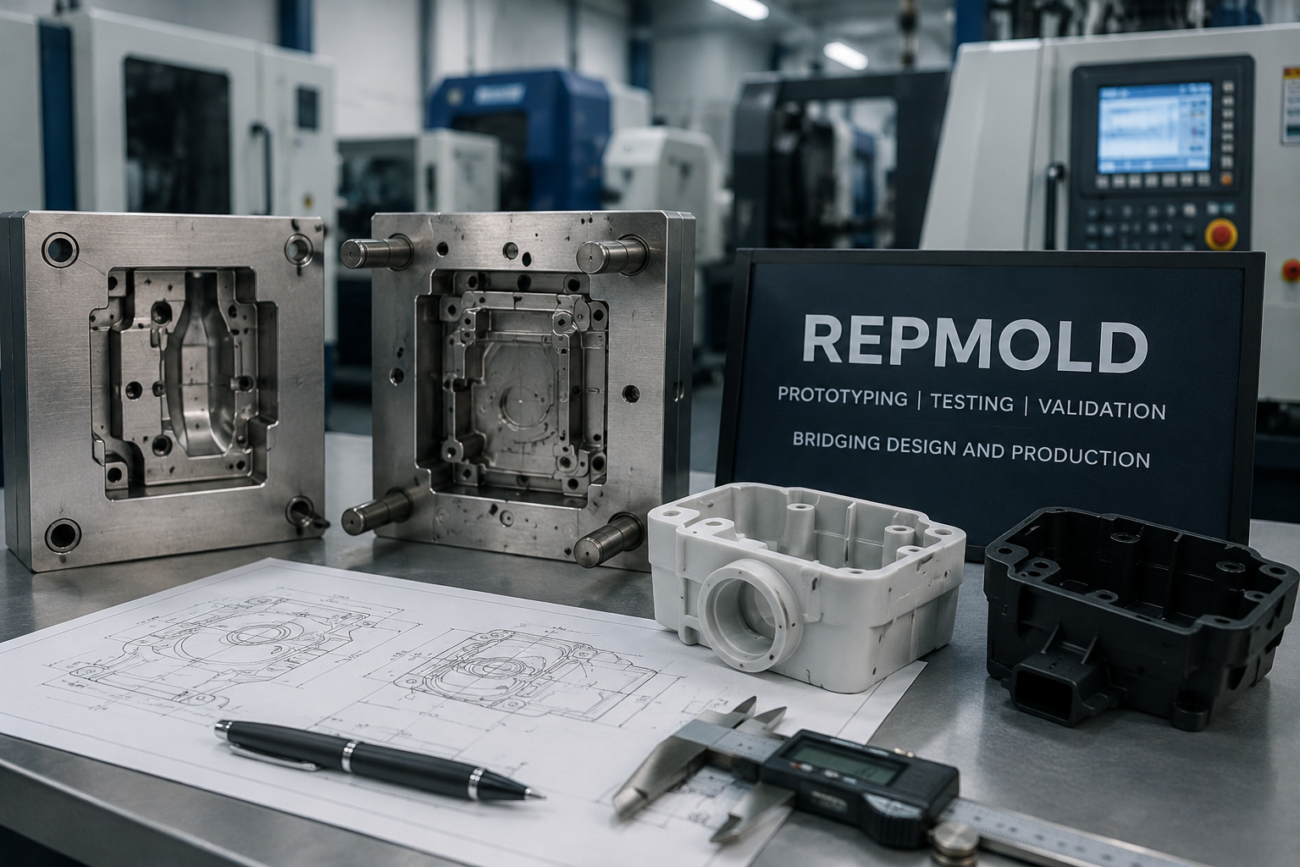
Manufacturing has changed dramatically over the past few decades. Products move from concept to market faster than ever, and companies constantly look for ways to reduce costs while maintaining quality. Within this environment, tools and processes that support efficient product development have become increasingly important. One term that often appears in discussions about industrial production, prototyping, and tooling is Repmold.
Although not as widely recognized outside manufacturing circles, Repmold plays a meaningful role in helping engineers, designers, and manufacturers bridge the gap between product ideas and full-scale production. Understanding how it works provides valuable insight into modern manufacturing practices and the methods used to bring products to market more efficiently.
What Is Repmold?
Repmold generally refers to a molding approach or tooling solution used to create prototype parts, low-volume production components, or replica products before large-scale manufacturing begins.
In practical terms, it serves as an intermediate step between design development and mass production. Instead of investing immediately in expensive production tooling, manufacturers can use Repmold-based methods to test designs, evaluate functionality, and identify potential improvements.
This approach is particularly useful when product specifications are still evolving or when companies need physical samples before committing to significant manufacturing investments.
Why Repmold Matters in Product Development
Product development rarely follows a perfectly straight path. Engineers often discover design challenges only after a physical part is produced and tested.
Digital models can predict performance to a certain extent, but real-world testing frequently reveals issues that software simulations miss. This is where Repmold becomes valuable.
By creating accurate molded prototypes or short-run components, teams can:
- Verify product dimensions
- Evaluate material performance
- Test assembly compatibility
- Gather customer feedback
- Reduce design risks before production
The ability to identify problems early often saves substantial time and money later in the manufacturing process.
The Relationship Between Repmold and Prototyping
Prototyping is one of the most important stages in modern manufacturing. A prototype allows stakeholders to see, touch, and evaluate a product before it enters mass production.
Repmold techniques support this process by producing parts that closely resemble final production components.
Unlike basic 3D-printed samples, molded prototypes often provide:
- Better surface finishes
- More realistic material properties
- Improved dimensional accuracy
- Functional testing capabilities
For industries where performance and precision matter, these characteristics can make a significant difference.
Example: Consumer Electronics
Consider a company developing a new wireless device.
The design team may create digital models and initial prototypes using additive manufacturing. However, before launching production, they often need samples made from the same materials intended for the final product.
Using Repmold processes allows the team to evaluate durability, fit, appearance, and user experience under realistic conditions.
Repmold in Modern Manufacturing
Manufacturing today emphasizes flexibility. Companies can no longer rely solely on lengthy production cycles because market demands change rapidly.
Repmold supports this flexibility by enabling faster iterations and lower-risk development.
Manufacturers commonly use it in:
- Automotive development
- Medical device production
- Aerospace engineering
- Consumer goods manufacturing
- Industrial equipment design
In each of these sectors, the ability to produce accurate prototype components can significantly influence project success.
How Repmold Supports Faster Product Launches
Speed has become a competitive advantage in nearly every industry.
A product that reaches the market months earlier than competitors often gains stronger customer recognition and market share.
Traditional production tooling can take considerable time to design and manufacture. Repmold solutions often require less investment and shorter lead times, making them attractive during development stages.
This allows teams to:
- Create prototype tooling.
- Produce sample parts.
- Test and refine designs.
- Approve final specifications.
- Transition to production tooling.
The process reduces delays and supports more efficient decision-making.
Common Materials Used in Repmold Applications
Material selection depends on the intended purpose of the prototype or production run.
Some projects prioritize appearance, while others focus on mechanical performance.
Common materials may include:
Thermoplastics
Thermoplastics are frequently used because they offer versatility, durability, and relatively low processing costs.
Examples include:
- ABS
- Polycarbonate
- Polypropylene
- Nylon
These materials are often chosen when functional testing is required.
Silicone-Based Materials
Silicone molds are popular for short-run production and prototype replication.
They can capture fine details and produce accurate copies of original components.
Resin Systems
Various resins are used when manufacturers require highly detailed parts or specific mechanical characteristics.
Resin-based molding solutions are particularly common during prototype development.
Benefits of Using Repmold
Several practical advantages explain why Repmold remains relevant in modern manufacturing environments.
Cost Efficiency
Full-scale production tooling can be expensive.
For products still under development, investing heavily in permanent tooling may not make financial sense. Repmold offers a lower-cost alternative during evaluation stages.
Design Validation
Physical testing reveals insights that digital models cannot always predict.
Manufacturers can identify dimensional issues, assembly problems, and material concerns before production begins.
Reduced Risk
Every design modification made after production starts can become costly.
By validating designs earlier, companies reduce the likelihood of expensive corrections later.
Improved Communication
Physical prototypes help designers, engineers, suppliers, and customers communicate more effectively.
A tangible sample often eliminates misunderstandings that can occur when reviewing drawings alone.
Challenges and Limitations of Repmold
While Repmold provides significant advantages, it is not suitable for every situation.
Manufacturers must consider certain limitations.
Not Always Ideal for High Volumes
When production volumes become very large, dedicated production tooling is usually more economical.
Repmold solutions are generally intended for prototypes, testing, or lower-volume runs.
Material Differences
Some prototype materials may not perfectly match final production materials.
As a result, testing outcomes should be interpreted carefully.
Tool Life Constraints
Certain rapid tooling or replica mold systems may wear out faster than production-grade molds.
This limitation is usually acceptable during development phases but can affect larger production requirements.
Repmold and Quality Assurance
Quality assurance begins long before a product reaches consumers.
One of the most valuable aspects of Repmold is its contribution to quality control during development.
Engineers can examine:
- Surface finish quality
- Structural integrity
- Assembly performance
- Tolerance accuracy
- Functional reliability
Identifying quality concerns at this stage helps prevent manufacturing defects later.
Many experienced manufacturers view prototype validation as an investment rather than an expense because it reduces downstream problems.
The Future of Repmold Technology
Manufacturing technologies continue to evolve.
Advances in digital design, simulation software, additive manufacturing, and automated tooling systems are influencing how prototype molds and replica tooling are produced.
Future developments may include:
- Faster mold production methods
- Greater material compatibility
- Enhanced digital integration
- Improved accuracy and repeatability
- More sustainable manufacturing practices
As product development cycles continue to shorten, the demand for efficient tooling and prototyping solutions is likely to remain strong.
Rather than replacing traditional manufacturing methods, Repmold technologies increasingly complement them, helping organizations move from concept to production with greater confidence.
Repmold and Industry Innovation
Innovation rarely occurs through a single breakthrough. More often, it results from many small improvements throughout the development process.
Repmold contributes to innovation by allowing teams to experiment, test, refine, and validate ideas before major production commitments are made.
Whether developing medical equipment, automotive components, consumer products, or industrial systems, manufacturers benefit from tools that support faster learning and informed decision-making.
In many ways, Repmold represents a practical response to one of manufacturing’s biggest challenges: turning ideas into reliable products without unnecessary risk.
Frequently Asked Questions
What is Repmold used for?
Repmold is commonly used for prototype development, product testing, low-volume manufacturing, and design validation before full-scale production begins.
Is Repmold the same as injection molding?
Not exactly. Repmold often supports prototype or short-run production, while traditional injection molding is typically associated with large-scale manufacturing.
Why do manufacturers use Repmold before production?
It helps identify design flaws, test materials, verify dimensions, and reduce the risk of costly changes after production tooling is created.
Can Repmold parts be functional?
Yes. Many Repmold-produced components are designed for functional testing and can closely replicate the performance of final production parts.
Is Repmold suitable for every manufacturing project?
No. Its value depends on project goals, production volume, budget, and development requirements. High-volume manufacturing generally requires dedicated production tooling.
Does Repmold help reduce manufacturing costs?
In many cases, yes. By allowing early testing and design improvements, it can prevent expensive tooling modifications and production errors later in the process.
Conclusion
Repmold is a valuable manufacturing solution that helps companies test, refine, and validate products before full-scale production. By reducing risks, lowering development costs, and improving design accuracy, it supports a smoother path from concept to market-ready product. As manufacturing continues to evolve, Repmold remains an important tool for efficient and reliable product development.
