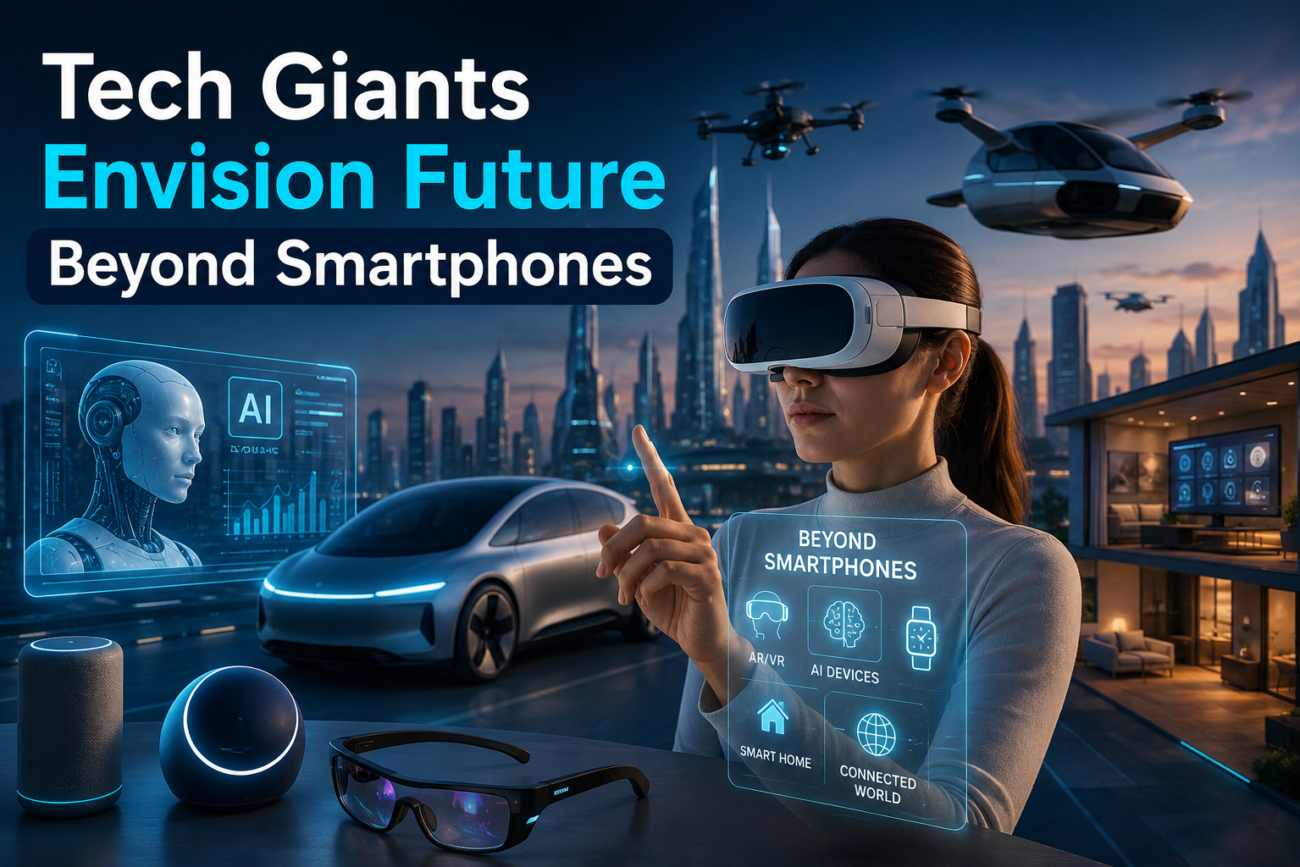
For more than a decade, smartphones have been at the center of our everyday lives. We use them for just about everything-from staying in touch with friends and family to working, shopping, and finding our way around. But that could be starting to change. As tech giants envision a future beyond smartphones, companies like Apple, Google, Meta, and Samsung are investing billions of dollars in wearable technology, spatial computing, and AI-powered devices that could eventually take the place of the phone in your pocket. And really, this isn’t just about launching the next big gadget. It’s about completely changing the way we interact with technology in our daily lives.
In this blog, we’ll explore why the smartphone’s dominance is being challenged, which technologies are leading the charge, and what this transition means for everyday users.
Why the Smartphone Era Is Slowing Down
Smartphone innovation has plateaued. Yearly upgrades now feel incremental-slightly better cameras, marginally faster chips-rather than revolutionary. Sales figures reflect this fatigue, with global smartphone shipments growing far slower than they did a decade ago. Consumers are holding onto their phones longer, and manufacturers know it.
This stagnation is a major reason tech giants envision a future beyond smartphones as the next logical business move. Innovation-hungry companies need a new frontier to justify R&D spending and capture consumer excitement again.
The Rise of Wearable and Ambient Computing
One of the clearest signals of this shift is the explosion of wearable technology. Smart glasses, AI pins, and advanced smartwatches are being positioned as smartphone companions – and eventually, replacements.
Smart Glasses Leading the Charge
Meta’s Ray-Ban smart glasses have already shown that consumers are willing to wear computing devices on their faces if the design feels natural. Apple, Google, and Samsung are reportedly developing similar products, betting that augmented reality overlays will eventually replace the need to glance down at a screen.
AI-Powered Wearables
Beyond glasses, standalone AI wearables are emerging as another category entirely. These devices aim to handle tasks through voice and ambient sensors, reducing dependency on touchscreens. While early attempts have had mixed reception, the underlying vision remains strong: computing that blends into daily life rather than demanding constant attention.
Spatial Computing and Mixed Reality
Apple’s Vision Pro and Meta’s Quest lineup represent a bolder bet – spatial computing. Instead of a small screen, these devices surround users with digital content layered onto the physical world. This is a core reason tech giants envision future beyond smartphones: spatial computing offers an entirely new interface paradigm, one where apps, communication, and entertainment exist in three-dimensional space rather than confined to a 6-inch display.
Although adoption is still in its early stages due to high costs and bulky hardware, companies are betting that miniaturization and price drops – much like what happened with smartphones themselves – will eventually make these devices mainstream.
AI as the New Operating Layer
Artificial intelligence is arguably the biggest force reshaping this transition. Rather than opening apps manually, users are increasingly expected to simply ask for what they need. Voice assistants, generative AI models, and predictive systems are becoming the primary interface, regardless of the hardware form factor.
This matters because it decouples the “brain” of computing from any single device. Whether you’re wearing smart glasses, using a wearable pin, or sitting at a desktop, AI can follow you across devices -making the smartphone just one access point among many, rather than the sole gateway.
What This Means for Consumers
For everyday users, this transition won’t happen overnight. Smartphones will likely remain central to daily life for years, but their role may shift from primary device to backup or hub device. Here’s what to expect in the near term:
- Gradual coexistence: Wearables and AI devices will complement smartphones before replacing them.
- New app ecosystems: Developers will need to design for voice, AR overlays, and ambient interfaces.
- Privacy considerations: Always-on cameras and microphones in wearables raise fresh concerns that companies must address.
- Battery and hardware limits: Miniaturized, all-day wearable computing is still a significant engineering challenge.
Challenges Standing in the Way
Despite the enthusiasm, several hurdles remain before this vision becomes reality. Battery life for compact wearables is still limited, AR display technology remains expensive to miniaturize, and public comfort with face-worn cameras is far from universal. Additionally, building an app ecosystem around a new form factor takes years, as seen with the slow but steady rise of smartwatches after their 2015 debut.
There’s also the question of habit. Smartphones are deeply embedded in how people communicate, navigate, and work. Convincing billions of users to change that behavior requires not just better hardware, but a genuinely compelling reason to switch.
Conclusion
The way tech giants envision the future beyond smartphones reflects a much bigger shift happening across the tech industry. The reality is, while smartphones still play a huge role in our daily lives, they’re no longer seen as the final step in personal computing. Instead, companies are investing heavily in wearables, spatial computing, and AI-powered interfaces because they believe these technologies will shape the next generation of digital experiences. In other words, these aren’t just experimental gadgets-they’re being built to become part of everyday life. For students interested in technology, including those at Cherrybrook Tech High, these innovations offer a glimpse into the kinds of digital tools and skills that could define future careers. While it may take a few more years before these technologies reach mainstream adoption, it’s becoming clear where things are headed. Going forward, computing won’t just be something we carry in our pockets. It’ll increasingly be something we wear, look through, and interact with simply by speaking. For both consumers and businesses, understanding this shift now can make it much easier to adapt to the technology of the next decade.
